The Downtown Development Authority of Fort Valley, Ga. 478-825-5986

Our Home: The Troutman House

The Historic Troutman House The Troutman House, circa 1855, is an example of Greek Revival style architecture and was one of the first larger stately homes built around Fort Valley. The original owner is thought to have been Colonel John Fielding Troutman Sr., who was a state senator and served on the staff of Governor Howell Cobb.

The historic Troutman House is located at the confluence of Georgia Hwy. 49, Georgia Hwy. 96 and Commercial Heights Blvd. in Fort Valley, Ga.

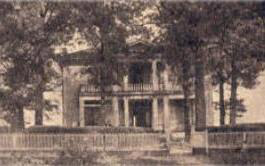
The house originally sat several thousand yards southeast of its present location (approximately where the Dairy Queen is now located on South Main Street) in a grove of trees surrounded by pasture land. After Troutman Sr. died in 1905, his son, John F. Troutman Jr. had the house moved to its present location. It is believed this transfer took place between 1906 and 1920 and helped provide a way to fully develop what is now known as the subdivision of Oakland Heights. The lot was originally four acres of land, and the home looks as if it stands at the end of Main Street, giving it a dramatic perspective and grand appearance.

Like many other stately homes, the Troutman house fell into disrepair over the years. However, the home has undergone an extensive renovation and now serves as home to the Downtown Development Authority and MainStreet, the Georgia Peach Festival, the Peach County Chamber of Commerce, the Welcome Center and the Peach County Development Authority.

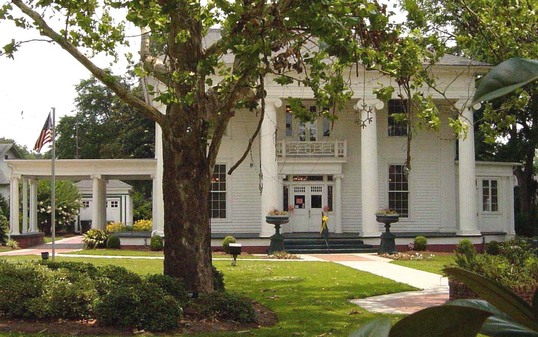
The Troutman House today
The Troutman House as it appears today after being lovingly restored as headquarters for a variety of community organizations including Main Street
The Troutman House in its original location
The Troutman House in its original location, several thousand yards southeast of its present location in a grove of trees surrounded by pasture lands.

Troutman House Architectural Information
The house is an example of Vernacular Greek Revival, a style prevalent in many towns of Georgia and the South between 1820 and 1860. This style is called Vernacular Greek Revival because, unlike pure Greek Revival, it includes square columns as well as the authentic Greek round columns of antiquity. The Smith House in Sparta with its 18 foot Corinthian columns each on a six-foot square Doric columns is a classic example of Venerable Greek Revival.

The front of the house has four round Corinthian columns on a full-facade porch. The plain crowns on windows of 48 panes identifies it immediately as Greek revival, while the square bases of the wall Corinthian columns on the house identify it as Vernacular Greek Revival. This does not subtract from its authenticity: approximately 40 percent of surviving Greek revival houses are estimated to be vernacular.

Above each column, between the roof and column, a unique design is added. The decorative trim immediately beneath the roof was frequently used in Greek revival.

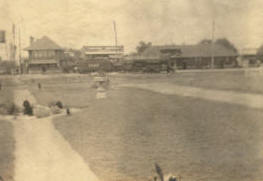
View from porch shows trains at station

The recessed front entrance with full transom light and half sidelights is framed by round Corinthian columns supporting a plain crown, giving a three dimensional effect. The two carved designs at the comers above each column is repeated elsewhere on the house.

The second story balcony is pure Greek revival, with double doors of eight panes each, double transoms of 12 panes each and a traditional railing of Greek design.

The porte-cochere with four round Corinthian columns, three full square Doric columns and two square Corinthian wall columns is probably part of the original but the three square columns were probably added later for stability. It has a flat roof typical of Greek revival extensions. The carriage house has the same square Doric columns with similar low-pitched hipped roof and square windowpanes. An architect who knew the style and the importance of detail evidently built it.

The horizontal window of the side entrance mirrors the horizontal window on the Southwest side. Several combinations of square window panes are used throughout: three horizontal panes and four vertical panes on the front downstairs, 3/4 second floor front, 3/6, even 7/3 for horizontal windows. Two matching planters are placed at each end of the bay window. The twin planters at the front steps are reminiscent of the small boxwoods frequently highlighting this style.

The sunroom on the South side of the front was added after the house was built, judging from the outside doorway and the weatherboard on the inside wall. But it is extremely well done. It has Doric Square columns with large square windowpanes. The design above the columns is the same as that at the entrance comers -obviously carved for the addition. Also, it is too close to the square bay window that extends two floors immediately behind it to have been original. The attractive room features windows on three sides.

Thousands crowded streets during the Festivals
Thousands crowded the streets during the festivals
The Peach Blossom Festivals, which were staged in Fort Valley from 1922 to 1926, took place right beside and behind the Troutman house. National Geographic writer Ralph A. Graves described the festival in the September 1926 issue.
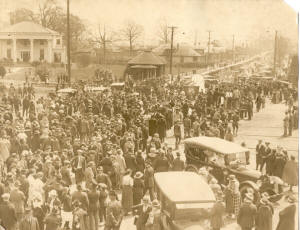
He wrote of the event as "a colorful, magnificently staged historical pageant ... which now attracts thousands to this progressive little town in the heart of the peach belt."

These festivals brought as many as 50,000 people to see the "peach capital of the world." The Troutman House still serves as a reminder of Fort Valley's earlier history and represents a vital part of the city's culture.